
Reception baseline assessment, child development, early years education
Reception baseline assessment, child development, early years education
The Truth Behind Reception Based Assessment
The Truth Behind Reception Based Assessment
The reception baseline assessment often arrives quietly, yet carries weight for both schools and families. It can feel unclear, even unsettling. This piece breaks down what it is, how it works, and what it actually means for your child’s early development.
The reception baseline assessment often arrives quietly, yet carries weight for both schools and families. It can feel unclear, even unsettling. This piece breaks down what it is, how it works, and what it actually means for your child’s early development.
The challenge
The challenge
Many parents hear about the reception baseline assessment and feel a quiet unease. What is it really measuring? And more importantly, who is it actually for? Before accepting the reassurance, it is worth looking a little closer.
Many parents hear about the reception baseline assessment and feel a quiet unease. What is it really measuring? And more importantly, who is it actually for? Before accepting the reassurance, it is worth looking a little closer.
Many parents hear about the reception baseline assessment and feel a quiet unease. What is it really measuring? And more importantly, who is it actually for? Before accepting the reassurance, it is worth looking a little closer.
Josh.E
Josh.E
The Journey
The Journey
Because once you understand what sits beneath this assessment, it becomes difficult to see it as harmless. The language, the purpose, and the timing begin to tell a different story, one that directly involves your child, whether you realised it or not.
The UK government is deeply concerned about children's mental health. They have commissioned reports, appointed commissioners, and published strategies. They have acknowledged a crisis. And then, in the same breath, they have mandated that four-year-old children who still sleep with a nightlight, who are still learning what the word school is, sit a formal assessment within six weeks of starting reception.
Make that make sense…
This is not a conspiracy theory. This is government policy. And before you scroll past thinking this does not affect you, or that it can't be that bad, or that the government surely wouldn't do something harmful to children, stop. Read this. Because your child is involved, whether you like it or not. It is mandatory. You do not get a say.
In 2023-2024, nearly 60,000 children were referred to mental health services in a state of crisis. One in five children aged 8-25 now has a diagnosable mental health difficulty. This is the backdrop against which the government decided to introduce formal assessments for four-year-olds.
Let me start with the language the government uses on its website, because words do matter, and such words tell you everything you need to know.
"If your child is starting Reception class, your child WILL participate"
This is not an invitation. This is not gentle reassurance. That is the language of ownership. Your four-year-old, whom you have spent every day loving, protecting, and raising, belongs to the government the moment they walk through that school door, and the government has decided they need to be assessed before they have even found their coat peg.
The purpose, according to the government, is to provide a starting point for a progress measure that will help parents understand how well schools support 'their pupils 'between reception and year 6.
Let that sink in
Not to help your child. Not to support your child. Not to understand your child. To measure to school.
Your four-year-old is a data collection tool for Ofsted's accountability framework. The DfE confirmed that this data will not even be published until 2028.
Your child's experience at age four (including the anxiety, the unfamiliar adult, and the questions) is generating a statistic that will sit in a government database for seven years before anyone even looks at it.
88% of reception teachers believe the RBA is a waste of their time. Just 1% thought it was a positive experience for children
- British Educational Research Journal, 2023
"It's Not About Judging or Labelling Your Child"
This is perhaps the most insulting line on the government's entire RBA information page. They have put it there because parents have said exactly that. Their children felt judged, labelled, and under pressure. The fact that they felt the need to write it tells you everything. You do not deny something that nobody has said.
"It's not about judging or labelling your child your putting them under any pressure. Your child cannot pass or fail the assessment"
Cannot pass or fail. So why are we doing it? Somebody explain to me what an assessment is, if not something with an outcome that measures performance. You have called it an assessment. You have assigned it a score. You have fed that score into a national database. But we are expected to believe there is no judgment involved.
A peer-reviewed study in the British Educational Research Journal found that the RBA produced fear, anxiety, despair, and humiliation in children. These are documented emotional responses. These are not opinions. These are the results of researchers sitting with children, observing them complete this assessment, and recording what happened.
Only 20% of Reception teachers believed the RBA provided an accurate picture of a child's ability. Because it does not measure ability. It measures background, preparation, and privilege.
A child whose parents have read to them every night, practised counting and letters, and attended a well-resourced nursery will perform differently from a child who hasn't had those opportunities — not because one child is more intelligent, but because one child had more support. What the RBA captures, in the majority of cases, is circumstance. And circumstance, once recorded as a baseline, follows that child through their entire primary education.
"It Gives Your Child Valuable One-to-One Time With Their Teacher."
Valuable. They actually used the word valuable
"The RBA gives your child valuable one-to-one time with their teacher at an early stage, helping them to understand your child better. It provides a helpful snapshot of your child's skills and abilities"
Let us talk about teachers for a moment, since the government has decided to invoke them as a selling point. Teachers in the UK are underpaid, overstretched, and leaving the profession at record rates. The last thing a Reception teacher needs is to sit one-to-one with twenty or more four-year-olds — one at a time — administering a digital assessment, recording the results, and uploading them to a national system. In the same weeks, they are also managing thirty children who are leaving their parents for the first time, who are learning what school is, who are crying, overwhelmed, and trying to understand a completely new world.
Valuable one-to-one time. What an extraordinary reframing of what is, in practice, an administrative burden layered onto an already exhausted workforce.
And the snapshot of your child's abilities? At four years old, a child's abilities include imagination beyond measure, physical endurance that puts adults to shame, emotional depth that most grown-ups have forgotten how to access, and a creativity that formal education will spend the next twelve years trying to educate out of them. Does the RBA measure any of that? No. It measures phonics, literacy, and maths. If your child is a builder, an artist, a storyteller, a runner or a dreamer, the RBA has nothing to say about who they are. But it will still assign them a number.
"It Will Benefit You as a Parent."
Here is the government's answer to how the RBA benefits you as a parent:
"When your child reaches Year 6, you will be able to see how well the school has supported your child's year group, compared to other schools nationally. The progress of individual pupils will not be reported."
Read that back slowly…
Your child undergoes this assessment at 4 years old. You spend six years watching them grow, attending parents' evenings, reading reports, helping with homework, and celebrating their achievements. And the benefit to you — the benefit the government is so proud of — is that in Year 6, you will see how your school compares to other schools nationally. Not how your child is doing. Not what your child needs. How the school ranks.
The progress of individual pupils will not be reported. So they have used your child's vulnerability at four years old to generate comparative school data, and your child sees nothing from it. You see nothing from it. It is a competition between institutions, dressed up in the language of parental benefit.
We used your child as a data point. We won't tell you how they personally did. But thanks, the school league tables will look great.
Notice also the language shift. When talking about benefits to you, your child disappears. They become a pupil. They become part of a year group. The warmth of the earlier framing, your child, your family, evaporates the moment we get to the actual purpose of this exercise.
"You Do Not Need to Prepare Your Child."
"You do not need to do anything to prepare your child for the assessment. Your child is unlikely to even know that they are taking part in an assessment when they are completing the tasks."
The fact that this question exists on the government website at all proves the point better than any argument could. Parents are worried. Parents are preparing. Parents are drilling phonics with three-year-olds. Parents are not letting their children go outside and play because they are terrified their child will fall behind before they have even begun. The government had to put this question there because the anxiety is already real, it is already widespread, and it is already affecting families across the country.
And then look at the answer. Unlikely. Not will not. Unlikely. Because some children do know. Some children know because the school told them. Some children know because their parents are stressed, and children feel everything, even when we think we are hiding it. The energy in a household where a parent is worried about their four-year-old's assessment results flows directly into that child. You cannot hide that anxiety. Developmental psychology has known this for decades.
A 2023 meta-analysis in the Journal of Affective Disorders, drawing on 52 studies across multiple countries, found that in 48 of those studies, academic pressure had a direct and significant association with anxiety, depression, and in the most severe cases, suicidal ideation in children.
We are not talking about exam stress in teenagers. We are talking about the cumulative, chronic effect of a system that begins measuring and sorting children from the very first weeks of their education. The RBA is not an isolated moment. It is the opening statement of a child's relationship with formal assessment, and that relationship, research tells us consistently, has profound consequences for mental health
The UK government is deeply concerned about children's mental health. They have commissioned reports, appointed commissioners, and published strategies. They have acknowledged a crisis. And then, in the same breath, they have mandated that four-year-old children who still sleep with a nightlight, who are still learning what the word school is, sit a formal assessment within six weeks of starting reception.
Make that make sense…
This is not a conspiracy theory. This is government policy. And before you scroll past thinking this does not affect you, or that it can't be that bad, or that the government surely wouldn't do something harmful to children, stop. Read this. Because your child is involved, whether you like it or not. It is mandatory. You do not get a say.
In 2023-2024, nearly 60,000 children were referred to mental health services in a state of crisis. One in five children aged 8-25 now has a diagnosable mental health difficulty. This is the backdrop against which the government decided to introduce formal assessments for four-year-olds.
Let me start with the language the government uses on its website, because words do matter, and such words tell you everything you need to know.
"If your child is starting Reception class, your child WILL participate"
This is not an invitation. This is not gentle reassurance. That is the language of ownership. Your four-year-old, whom you have spent every day loving, protecting, and raising, belongs to the government the moment they walk through that school door, and the government has decided they need to be assessed before they have even found their coat peg.
The purpose, according to the government, is to provide a starting point for a progress measure that will help parents understand how well schools support 'their pupils 'between reception and year 6.
Let that sink in
Not to help your child. Not to support your child. Not to understand your child. To measure to school.
Your four-year-old is a data collection tool for Ofsted's accountability framework. The DfE confirmed that this data will not even be published until 2028.
Your child's experience at age four (including the anxiety, the unfamiliar adult, and the questions) is generating a statistic that will sit in a government database for seven years before anyone even looks at it.
88% of reception teachers believe the RBA is a waste of their time. Just 1% thought it was a positive experience for children
- British Educational Research Journal, 2023
"It's Not About Judging or Labelling Your Child"
This is perhaps the most insulting line on the government's entire RBA information page. They have put it there because parents have said exactly that. Their children felt judged, labelled, and under pressure. The fact that they felt the need to write it tells you everything. You do not deny something that nobody has said.
"It's not about judging or labelling your child your putting them under any pressure. Your child cannot pass or fail the assessment"
Cannot pass or fail. So why are we doing it? Somebody explain to me what an assessment is, if not something with an outcome that measures performance. You have called it an assessment. You have assigned it a score. You have fed that score into a national database. But we are expected to believe there is no judgment involved.
A peer-reviewed study in the British Educational Research Journal found that the RBA produced fear, anxiety, despair, and humiliation in children. These are documented emotional responses. These are not opinions. These are the results of researchers sitting with children, observing them complete this assessment, and recording what happened.
Only 20% of Reception teachers believed the RBA provided an accurate picture of a child's ability. Because it does not measure ability. It measures background, preparation, and privilege.
A child whose parents have read to them every night, practised counting and letters, and attended a well-resourced nursery will perform differently from a child who hasn't had those opportunities — not because one child is more intelligent, but because one child had more support. What the RBA captures, in the majority of cases, is circumstance. And circumstance, once recorded as a baseline, follows that child through their entire primary education.
"It Gives Your Child Valuable One-to-One Time With Their Teacher."
Valuable. They actually used the word valuable
"The RBA gives your child valuable one-to-one time with their teacher at an early stage, helping them to understand your child better. It provides a helpful snapshot of your child's skills and abilities"
Let us talk about teachers for a moment, since the government has decided to invoke them as a selling point. Teachers in the UK are underpaid, overstretched, and leaving the profession at record rates. The last thing a Reception teacher needs is to sit one-to-one with twenty or more four-year-olds — one at a time — administering a digital assessment, recording the results, and uploading them to a national system. In the same weeks, they are also managing thirty children who are leaving their parents for the first time, who are learning what school is, who are crying, overwhelmed, and trying to understand a completely new world.
Valuable one-to-one time. What an extraordinary reframing of what is, in practice, an administrative burden layered onto an already exhausted workforce.
And the snapshot of your child's abilities? At four years old, a child's abilities include imagination beyond measure, physical endurance that puts adults to shame, emotional depth that most grown-ups have forgotten how to access, and a creativity that formal education will spend the next twelve years trying to educate out of them. Does the RBA measure any of that? No. It measures phonics, literacy, and maths. If your child is a builder, an artist, a storyteller, a runner or a dreamer, the RBA has nothing to say about who they are. But it will still assign them a number.
"It Will Benefit You as a Parent."
Here is the government's answer to how the RBA benefits you as a parent:
"When your child reaches Year 6, you will be able to see how well the school has supported your child's year group, compared to other schools nationally. The progress of individual pupils will not be reported."
Read that back slowly…
Your child undergoes this assessment at 4 years old. You spend six years watching them grow, attending parents' evenings, reading reports, helping with homework, and celebrating their achievements. And the benefit to you — the benefit the government is so proud of — is that in Year 6, you will see how your school compares to other schools nationally. Not how your child is doing. Not what your child needs. How the school ranks.
The progress of individual pupils will not be reported. So they have used your child's vulnerability at four years old to generate comparative school data, and your child sees nothing from it. You see nothing from it. It is a competition between institutions, dressed up in the language of parental benefit.
We used your child as a data point. We won't tell you how they personally did. But thanks, the school league tables will look great.
Notice also the language shift. When talking about benefits to you, your child disappears. They become a pupil. They become part of a year group. The warmth of the earlier framing, your child, your family, evaporates the moment we get to the actual purpose of this exercise.
"You Do Not Need to Prepare Your Child."
"You do not need to do anything to prepare your child for the assessment. Your child is unlikely to even know that they are taking part in an assessment when they are completing the tasks."
The fact that this question exists on the government website at all proves the point better than any argument could. Parents are worried. Parents are preparing. Parents are drilling phonics with three-year-olds. Parents are not letting their children go outside and play because they are terrified their child will fall behind before they have even begun. The government had to put this question there because the anxiety is already real, it is already widespread, and it is already affecting families across the country.
And then look at the answer. Unlikely. Not will not. Unlikely. Because some children do know. Some children know because the school told them. Some children know because their parents are stressed, and children feel everything, even when we think we are hiding it. The energy in a household where a parent is worried about their four-year-old's assessment results flows directly into that child. You cannot hide that anxiety. Developmental psychology has known this for decades.
A 2023 meta-analysis in the Journal of Affective Disorders, drawing on 52 studies across multiple countries, found that in 48 of those studies, academic pressure had a direct and significant association with anxiety, depression, and in the most severe cases, suicidal ideation in children.
We are not talking about exam stress in teenagers. We are talking about the cumulative, chronic effect of a system that begins measuring and sorting children from the very first weeks of their education. The RBA is not an isolated moment. It is the opening statement of a child's relationship with formal assessment, and that relationship, research tells us consistently, has profound consequences for mental health
“Before your child has even found their place in the classroom, the system has already decided to measure them.”
“Before your child has even found their place in the classroom, the system has already decided to measure them.”
Josh.E
Josh.E
“Before your child has even found their place in the classroom, the system has already decided to measure them.”
Josh.E
"The Assessment Has Been Designed to Be Inclusive."
"The assessment has been designed to be inclusive and accessible for as many children as possible. This includes those with special educational needs and disabilities (SEND)."
So now we are assessing children with special educational needs within weeks of starting Reception. Children who may have just received a diagnosis. Children whose parents are still in the overwhelming early stages of understanding what that diagnosis means, what support their child needs, and what their child's future looks like. And the government's response to those parents is: don't worry, we have made it accessible.
Accessible means a teacher can pause the assessment if the child needs a break. It means adaptations can be made. It means someone has thought about visual and hearing impairments. What it does not mean is that sitting a child with autism, sensory processing difficulties, speech and language delays, or severe anxiety in front of an unfamiliar adult with a touchscreen device for a formal assessment is a good idea. Accessible does not mean appropriate. Accessible does not mean beneficial. Accessible means we have technically included everyone in a process that should not exist in the first place.
And then — the final line that captures everything:
"If you have any concerns about your child accessing the assessment, you should discuss this with your child's school."
If you have any concerns. There it is. The government's acknowledgement that parents will have concerns, followed immediately by the redirection of those concerns away from the government and onto the school. Not: we hear your concerns. Not: here is how we are addressing the evidence that this causes harm. Speak to the school. Manage it locally. Don't escalate. This is happening regardless.
Screen Time for the Government, But Not for Your Child
One more thing the government's own website reveals, almost as an aside:
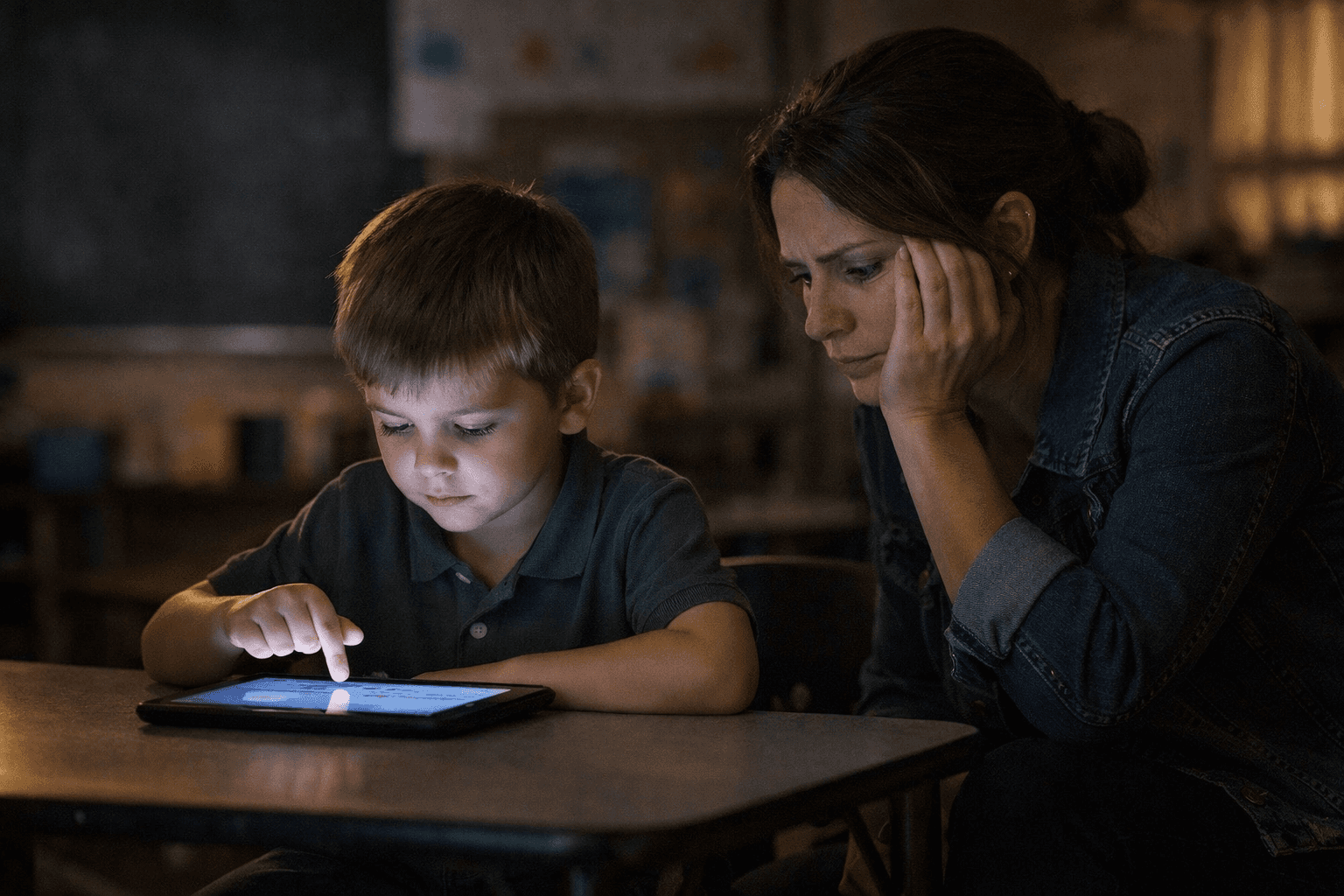
"Your child will complete the assessment using a touchscreen device.
This is the same government that is currently discussing excessive screen time in children. The same government that has debated phone bans in schools. The same government that has funded research about the impact of screens on developing brains. And the RBA, the mandatory, national, no-opt-out assessment for four-year-olds, is delivered on a touchscreen. Not because it is better for children. Because it is more efficient for data collection.
What Other Countries Know That We Don't
While the UK is formally assessing four-year-olds, Finland is letting them play.
In Finland, formal schooling does not begin until age seven. Before that, children spend years in play-based environments, developing curiosity, problem-solving, social skills, and a love of learning that no assessment can manufacture. There are no standardised tests. There are no baseline scores. There is, instead, a foundational national belief that childhood is not a data problem to be solved, but a stage of life to be protected.
Finland consistently ranks among the highest-performing education systems in the world. Children who experience play-based early education demonstrate better academic outcomes in later years, stronger concentration, improved social behaviour, and significantly greater intrinsic motivation to learn.
Poland, too, reformed its education system by moving the school starting age back to seven and saw its international rankings rise substantially as a result. The evidence is not ambiguous. Earlier formal assessment does not produce better outcomes. It produces earlier anxiety.
Research on early brain development consistently shows that the years from zero to five are the most critical for forming the neural pathways that underpin all future learning. The expert consensus on how best to use those years is clear: play, relationships, safety, exploration, and joy. The UK government's approach is: a touchscreen assessment with a stranger before the child has learned where the toilets are.
The Myth That Children Need Structured Learning Before Age Four
There is a quiet but significant piece of context that rarely makes it into conversations about the RBA, and it is worth naming directly.
The idea that children need structured educational input from the earliest possible age. Nursery at two, phonics at three, assessment at four, is not an ancient truth. It is a relatively recent and largely commercial narrative. Generations of children were raised by parents and extended families, spending their early years in unstructured play, in community, in the rhythms of everyday life. They developed. They thrived. They went on to be curious, capable, contributing members of society without a single baseline score.
The commercialisation of early childhood has been enormously profitable. It has also been enormously anxiety-inducing for parents, who are now made to feel that every unstructured hour is a developmental opportunity missed. The RBA fits neatly into this narrative. It tells parents, implicitly, that their child's readiness for school is something that can and should be measured, which means it is something that can be got wrong. Which means there is something to worry about. Which means there is something to fix
There is not. A four-year-old playing in the garden, making up stories, negotiating with a sibling, getting muddy, building something that falls down and building it again. That child is developing exactly as they should. The RBA has nothing to say about any of it.
This Is Not a Test. It Is a Statement.
The Reception Baseline Assessment tells every four-year-old in England something before they have even settled into their classroom. It tells them that who they are right now, at this moment, in front of this stranger, with this device, needs to be recorded, measured, and stored. It tells them that education is something that is done to them, not something they are invited to explore.
It tells parents that their anxiety is appropriate. That there is, in fact, something to prepare for. That their child's entry into school is an assessment event, not a beginning.
And it tells teachers, already overstretched, underpaid, and under-supported, that their professional knowledge of the children in their class is less important than a digitally recorded score generated in the child's first six weeks.
The government says this is about supporting children. The evidence says it produces fear, anxiety, and humiliation. The government says it benefits parents. The evidence says individual children gain nothing from it. The government says it is not about judgment. The evidence says it measures background and circumstance, not ability or potential.
One in five children in the UK now has a mental health difficulty. The Children's Commissioner has called it a crisis. And the government's response was to introduce mandatory formal assessments at age four. Ask yourself: DOES THIS ADD UP?
You are allowed to be angry. You are allowed to ask questions. You are allowed to look at a government webpage that uses the word 'WILL' in capital letters about your four-year-old and feel deeply uncomfortable. You are allowed to look at the research, the teacher surveys, the peer-reviewed journals, and the international comparisons, and conclude that this policy is not about your child at all.
Because it isn't.
Childhood is not a baseline. It is not a data point. It is not an administrative inconvenience on the way to Year 6 progress measures. It is the most important and irretrievable time in a human being's life. And right now, in England, we are spending those years measuring it rather than protecting it.
That should make every single one of us furious.
For more information about the reception based assessment yon can visit the government website.
You can read a journal Why are we tracking reception aged children? published by Wolverhampton university
"The Assessment Has Been Designed to Be Inclusive."
"The assessment has been designed to be inclusive and accessible for as many children as possible. This includes those with special educational needs and disabilities (SEND)."
So now we are assessing children with special educational needs within weeks of starting Reception. Children who may have just received a diagnosis. Children whose parents are still in the overwhelming early stages of understanding what that diagnosis means, what support their child needs, and what their child's future looks like. And the government's response to those parents is: don't worry, we have made it accessible.
Accessible means a teacher can pause the assessment if the child needs a break. It means adaptations can be made. It means someone has thought about visual and hearing impairments. What it does not mean is that sitting a child with autism, sensory processing difficulties, speech and language delays, or severe anxiety in front of an unfamiliar adult with a touchscreen device for a formal assessment is a good idea. Accessible does not mean appropriate. Accessible does not mean beneficial. Accessible means we have technically included everyone in a process that should not exist in the first place.
And then — the final line that captures everything:
"If you have any concerns about your child accessing the assessment, you should discuss this with your child's school."
If you have any concerns. There it is. The government's acknowledgement that parents will have concerns, followed immediately by the redirection of those concerns away from the government and onto the school. Not: we hear your concerns. Not: here is how we are addressing the evidence that this causes harm. Speak to the school. Manage it locally. Don't escalate. This is happening regardless.
Screen Time for the Government, But Not for Your Child
One more thing the government's own website reveals, almost as an aside:
"Your child will complete the assessment using a touchscreen device.
This is the same government that is currently discussing excessive screen time in children. The same government that has debated phone bans in schools. The same government that has funded research about the impact of screens on developing brains. And the RBA, the mandatory, national, no-opt-out assessment for four-year-olds, is delivered on a touchscreen. Not because it is better for children. Because it is more efficient for data collection.
What Other Countries Know That We Don't
While the UK is formally assessing four-year-olds, Finland is letting them play.
In Finland, formal schooling does not begin until age seven. Before that, children spend years in play-based environments, developing curiosity, problem-solving, social skills, and a love of learning that no assessment can manufacture. There are no standardised tests. There are no baseline scores. There is, instead, a foundational national belief that childhood is not a data problem to be solved, but a stage of life to be protected.
Finland consistently ranks among the highest-performing education systems in the world. Children who experience play-based early education demonstrate better academic outcomes in later years, stronger concentration, improved social behaviour, and significantly greater intrinsic motivation to learn.
Poland, too, reformed its education system by moving the school starting age back to seven and saw its international rankings rise substantially as a result. The evidence is not ambiguous. Earlier formal assessment does not produce better outcomes. It produces earlier anxiety.
Research on early brain development consistently shows that the years from zero to five are the most critical for forming the neural pathways that underpin all future learning. The expert consensus on how best to use those years is clear: play, relationships, safety, exploration, and joy. The UK government's approach is: a touchscreen assessment with a stranger before the child has learned where the toilets are.
The Myth That Children Need Structured Learning Before Age Four
There is a quiet but significant piece of context that rarely makes it into conversations about the RBA, and it is worth naming directly.
The idea that children need structured educational input from the earliest possible age. Nursery at two, phonics at three, assessment at four, is not an ancient truth. It is a relatively recent and largely commercial narrative. Generations of children were raised by parents and extended families, spending their early years in unstructured play, in community, in the rhythms of everyday life. They developed. They thrived. They went on to be curious, capable, contributing members of society without a single baseline score.
The commercialisation of early childhood has been enormously profitable. It has also been enormously anxiety-inducing for parents, who are now made to feel that every unstructured hour is a developmental opportunity missed. The RBA fits neatly into this narrative. It tells parents, implicitly, that their child's readiness for school is something that can and should be measured, which means it is something that can be got wrong. Which means there is something to worry about. Which means there is something to fix
There is not. A four-year-old playing in the garden, making up stories, negotiating with a sibling, getting muddy, building something that falls down and building it again. That child is developing exactly as they should. The RBA has nothing to say about any of it.
This Is Not a Test. It Is a Statement.
The Reception Baseline Assessment tells every four-year-old in England something before they have even settled into their classroom. It tells them that who they are right now, at this moment, in front of this stranger, with this device, needs to be recorded, measured, and stored. It tells them that education is something that is done to them, not something they are invited to explore.
It tells parents that their anxiety is appropriate. That there is, in fact, something to prepare for. That their child's entry into school is an assessment event, not a beginning.
And it tells teachers, already overstretched, underpaid, and under-supported, that their professional knowledge of the children in their class is less important than a digitally recorded score generated in the child's first six weeks.
The government says this is about supporting children. The evidence says it produces fear, anxiety, and humiliation. The government says it benefits parents. The evidence says individual children gain nothing from it. The government says it is not about judgment. The evidence says it measures background and circumstance, not ability or potential.
One in five children in the UK now has a mental health difficulty. The Children's Commissioner has called it a crisis. And the government's response was to introduce mandatory formal assessments at age four. Ask yourself: DOES THIS ADD UP?
You are allowed to be angry. You are allowed to ask questions. You are allowed to look at a government webpage that uses the word 'WILL' in capital letters about your four-year-old and feel deeply uncomfortable. You are allowed to look at the research, the teacher surveys, the peer-reviewed journals, and the international comparisons, and conclude that this policy is not about your child at all.
Because it isn't.
Childhood is not a baseline. It is not a data point. It is not an administrative inconvenience on the way to Year 6 progress measures. It is the most important and irretrievable time in a human being's life. And right now, in England, we are spending those years measuring it rather than protecting it.
That should make every single one of us furious.
For more information about the reception based assessment yon can visit the government website.
You can read a journal Why are we tracking reception aged children? published by Wolverhampton university
Ready to find your path?
Ready to find your path?
If this story resonates with you, maybe it’s time to start your own journey
If this story resonates with you, maybe it’s time to start your own journey
Prefer to chat first? Send me an email or connect with us on social, I'm always happy to help.
Prefer to chat first? Send me an email or connect with us on social, I'm always happy to help.