
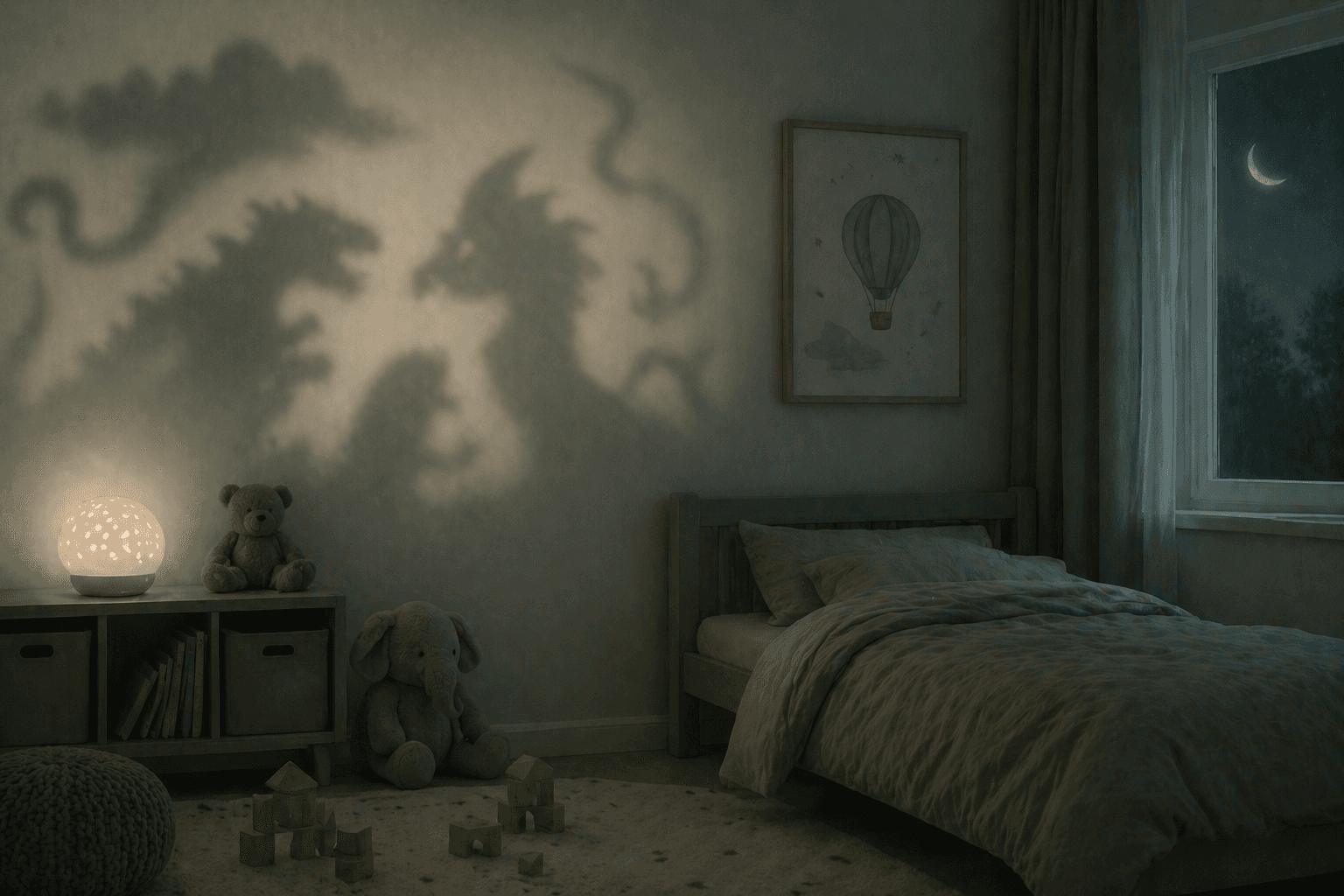
Child Development, Night Terrors, Child Sleep
Child Development, Night Terrors, Child Sleep
Why Do Children Have Night Terrors
Why Do Children Have Night Terrors
Night terrors can feel sudden and unsettling, but beneath the intensity lies a child’s developing mind trying to make sense of emotions it does not yet have the words to express.
Night terrors can feel sudden and unsettling, but beneath the intensity lies a child’s developing mind trying to make sense of emotions it does not yet have the words to express.
Sound Familiar
Sound Familiar
Your child suddenly sits up in bed, crying or screaming. Their eyes are open, but they do not seem to recognise you. You try to comfort them, but they push you away. It feels intense, almost like panic. Then, just as quickly, it ends. By morning, they remember nothing. You are left wondering what just happened.
Your child suddenly sits up in bed, crying or screaming. Their eyes are open, but they do not seem to recognise you. You try to comfort them, but they push you away. It feels intense, almost like panic. Then, just as quickly, it ends. By morning, they remember nothing. You are left wondering what just happened.
Your child suddenly sits up in bed, crying or screaming. Their eyes are open, but they do not seem to recognise you. You try to comfort them, but they push you away. It feels intense, almost like panic. Then, just as quickly, it ends. By morning, they remember nothing. You are left wondering what just happened.
Josh Ezekiel
Josh Ezekiel
The Journey
The Journey
One moment, your child is asleep, and the next, they are crying out, eyes open but not really there, pushing you away when you try to help. It feels intense, confusing, and oddly helpless, like you are watching something you cannot reach. You might start questioning everything: their sleep, your routine, even yourself. And the hardest part is waking up the next morning with no answers, because they remember nothing, but you remember everything.
What Night Terrors Really Are
Let’s begin with clarity.
Night terrors are not nightmares.
Nightmares happen during lighter sleep, often in the later part of the night, and children can usually remember them. Night terrors happen during deep sleep, typically within the first few hours after falling asleep. The child is not fully conscious, which is why they seem unreachable.
From a biological perspective, night terrors are linked to the nervous system. The brain is transitioning between sleep stages, and something misfires. The body reacts as if it is under threat.
That explains how they happen.
But it does not fully explain why.
This is where a psychoanalytic perspective adds something far more meaningful.
Children are not just learning how to walk, talk, and play. They are also learning how to feel, how to manage emotion, and how to make sense of their experiences.
And this process is far from simple.
Throughout the day, your child absorbs far more than you might realise. Small changes in routine, tone of voice, separation, new environments, overstimulation, and even subtle emotional shifts in you as a parent. These experiences do not just disappear. They are held somewhere inside.
For adults, we process this through language. We talk, think, reflect.
Children cannot do this yet.
Instead, they process through the body, through behaviour, and through symbolic expression.
Sleep becomes one of the few spaces where the mind begins to organise these unprocessed experiences.
In psychoanalytic thinking, this is closely linked to the idea of the internal world. Your child carries an inner emotional landscape made up of feelings, impressions, and early relational experiences. During the day, this world is managed through distraction, play, and connection. At night, when the external structure fades, the internal world becomes more active.
A night terror can be understood as a moment where something internal becomes overwhelming.
Not dangerous. Not pathological. Overwhelming.
Think of it less as something going wrong and more as something trying to come into awareness without the tools to be understood.
For example:
Starting Nursery
Changes in caregivers
A new sibling
Parental Stress
Even developmental leaps
These experiences can feel disorganising to a child. They may not cry about it during the day. They may even seem 'fine'. But internally, something is being worked through.
Psychoanalyst Wilfred Bion introduced the concept of containment. in simple terms, your child relies on you to help hold and process emotional experiences they cannot yet manage alone. When this process is incomplete, those feelings remain unprocessed.
At night, without external containment, they can emerge in raw form.
This is what a night terror often looks like.
Not a dream with a storyline, but a surge of emotion without language.
Not fear of something specific, but a state of being overwhelmed.
This is why your child cannot respond to you in the moment. They are not choosing to ignore you. They are not “misbehaving.” They are in a state where thinking has temporarily shut down, and feeling has taken over.
There is also an important developmental layer here.
Between roughly ages 2 and 7, children are developing imagination, symbolic thinking, and emotional awareness. This is a powerful but unstable period. Their inner world expands faster than their ability to regulate it.
Night terrors often sit right in the middle of this stage.
From the outside, it looks chaotic.
From the inside, it may be part of the mind trying to organise itself.
For more information about night terrors, check out the NHS website here
The Sleep Foundation provide some helpful insights into night terrors
The National Library of Medicine have a brilliant article on night terrors in children
What Night Terrors Really Are
Let’s begin with clarity.
Night terrors are not nightmares.
Nightmares happen during lighter sleep, often in the later part of the night, and children can usually remember them. Night terrors happen during deep sleep, typically within the first few hours after falling asleep. The child is not fully conscious, which is why they seem unreachable.
From a biological perspective, night terrors are linked to the nervous system. The brain is transitioning between sleep stages, and something misfires. The body reacts as if it is under threat.
That explains how they happen.
But it does not fully explain why.
This is where a psychoanalytic perspective adds something far more meaningful.
Children are not just learning how to walk, talk, and play. They are also learning how to feel, how to manage emotion, and how to make sense of their experiences.
And this process is far from simple.
Throughout the day, your child absorbs far more than you might realise. Small changes in routine, tone of voice, separation, new environments, overstimulation, and even subtle emotional shifts in you as a parent. These experiences do not just disappear. They are held somewhere inside.
For adults, we process this through language. We talk, think, reflect.
Children cannot do this yet.
Instead, they process through the body, through behaviour, and through symbolic expression.
Sleep becomes one of the few spaces where the mind begins to organise these unprocessed experiences.
In psychoanalytic thinking, this is closely linked to the idea of the internal world. Your child carries an inner emotional landscape made up of feelings, impressions, and early relational experiences. During the day, this world is managed through distraction, play, and connection. At night, when the external structure fades, the internal world becomes more active.
A night terror can be understood as a moment where something internal becomes overwhelming.
Not dangerous. Not pathological. Overwhelming.
Think of it less as something going wrong and more as something trying to come into awareness without the tools to be understood.
For example:
Starting Nursery
Changes in caregivers
A new sibling
Parental Stress
Even developmental leaps
These experiences can feel disorganising to a child. They may not cry about it during the day. They may even seem 'fine'. But internally, something is being worked through.
Psychoanalyst Wilfred Bion introduced the concept of containment. in simple terms, your child relies on you to help hold and process emotional experiences they cannot yet manage alone. When this process is incomplete, those feelings remain unprocessed.
At night, without external containment, they can emerge in raw form.
This is what a night terror often looks like.
Not a dream with a storyline, but a surge of emotion without language.
Not fear of something specific, but a state of being overwhelmed.
This is why your child cannot respond to you in the moment. They are not choosing to ignore you. They are not “misbehaving.” They are in a state where thinking has temporarily shut down, and feeling has taken over.
There is also an important developmental layer here.
Between roughly ages 2 and 7, children are developing imagination, symbolic thinking, and emotional awareness. This is a powerful but unstable period. Their inner world expands faster than their ability to regulate it.
Night terrors often sit right in the middle of this stage.
From the outside, it looks chaotic.
From the inside, it may be part of the mind trying to organise itself.
For more information about night terrors, check out the NHS website here
The Sleep Foundation provide some helpful insights into night terrors
The National Library of Medicine have a brilliant article on night terrors in children
“A child’s night terror is rarely about the dark in the room. It is often about the parts of their inner world that are still searching for light.” - Josh E
“A child’s night terror is rarely about the dark in the room. It is often about the parts of their inner world that are still searching for light.” - Josh E
Josh Ezekiel
Josh Ezekiel
“A child’s night terror is rarely about the dark in the room. It is often about the parts of their inner world that are still searching for light.” - Josh E
Josh Ezekiel
What Parents Can Actually Do
When a night terror happens, your instinct is to fix it.
To wake them. To calm them. To stop it.
But this is one of those moments when doing less and understanding more becomes far more effective.
Start with the moment itself.
Do not try to fully wake your child unless necessary for safety. Waking them can prolong the episode and create more confusion. Instead, stay nearby. Lower your voice. Reduce stimulation.
Your presence matters more than your intervention.
You are acting as a quiet anchor, even if it does not seem like it.
Now shift your focus to the day.
Night terrors are rarely just about the night.
Ask yourself:
Has anything changed recently?
Has my child been more clingy, withdrawn, or irritable?
Have routines shifted?
Have I been more stressed or distracted?
Children are incredibly sensitive to emotional environments. They pick up what is not said just as much as what is.
This does not mean you are doing anything wrong.
It means your child is responding.
One of the most powerful things you can do is build emotional safety before sleep.
This is not about perfection. It is about consistency and connection.
A simple, predictable bedtime routine creates structure. But more importantly, moments of emotional attunement create containment.
This Might Look Like:
Sitting together quietly before bed
Reading slowly, without rushing
Gentle physical closeness
Naming simple feelings from the day
You are not analysing your child, you are helping them feel held.
Overtime, this reduces the intensity of what needs to be processed during sleep time. There is also a mindset shift that can change everything.
Most advice online focuses on stopping night terrors.
But what if the goal is not immediate elimination?
What if the goal is understanding what they represent?
When you shift from 'How do I stop this? to 'What might this be expressing?', your whole approach changes.
You become less reactive, more curious
Less focused on control, more focused on connection.
And this matters.
Children do not just need their behaviour managed. They need their experiences understood.
In most cases, night terrors reduce over time.
As your child develops language, emotional awareness, and the ability to symbolise their experiences, these intense, non-verbal expressions become less necessary.
What once came out as a scream in the night becomes something they can say, think, or play out during the day.
This is development in motion.
There are, however, moments where additional support may be needed.
If night terrors are happening very frequently, worsening, or paired with significant daytime distress, it may be worth speaking to a professional.
Not because something is “wrong,” but because more support may be helpful in understanding what your child is carrying.
But for most families, night terrors are a phase.
A difficult one, but a meaningful one.
They remind us of something important.
Children are not just small adults learning rules and routines.
They are developing minds, trying to make sense of a world that is often bigger than they can hold.
Sometimes, that process spills into the night.
And when it does, your role is not to fix it instantly.
It is to stay close, stay steady, and trust that even in the chaos, something is growing.
What Parents Can Actually Do
When a night terror happens, your instinct is to fix it.
To wake them. To calm them. To stop it.
But this is one of those moments when doing less and understanding more becomes far more effective.
Start with the moment itself.
Do not try to fully wake your child unless necessary for safety. Waking them can prolong the episode and create more confusion. Instead, stay nearby. Lower your voice. Reduce stimulation.
Your presence matters more than your intervention.
You are acting as a quiet anchor, even if it does not seem like it.
Now shift your focus to the day.
Night terrors are rarely just about the night.
Ask yourself:
Has anything changed recently?
Has my child been more clingy, withdrawn, or irritable?
Have routines shifted?
Have I been more stressed or distracted?
Children are incredibly sensitive to emotional environments. They pick up what is not said just as much as what is.
This does not mean you are doing anything wrong.
It means your child is responding.
One of the most powerful things you can do is build emotional safety before sleep.
This is not about perfection. It is about consistency and connection.
A simple, predictable bedtime routine creates structure. But more importantly, moments of emotional attunement create containment.
This Might Look Like:
Sitting together quietly before bed
Reading slowly, without rushing
Gentle physical closeness
Naming simple feelings from the day
You are not analysing your child, you are helping them feel held.
Overtime, this reduces the intensity of what needs to be processed during sleep time. There is also a mindset shift that can change everything.
Most advice online focuses on stopping night terrors.
But what if the goal is not immediate elimination?
What if the goal is understanding what they represent?
When you shift from 'How do I stop this? to 'What might this be expressing?', your whole approach changes.
You become less reactive, more curious
Less focused on control, more focused on connection.
And this matters.
Children do not just need their behaviour managed. They need their experiences understood.
In most cases, night terrors reduce over time.
As your child develops language, emotional awareness, and the ability to symbolise their experiences, these intense, non-verbal expressions become less necessary.
What once came out as a scream in the night becomes something they can say, think, or play out during the day.
This is development in motion.
There are, however, moments where additional support may be needed.
If night terrors are happening very frequently, worsening, or paired with significant daytime distress, it may be worth speaking to a professional.
Not because something is “wrong,” but because more support may be helpful in understanding what your child is carrying.
But for most families, night terrors are a phase.
A difficult one, but a meaningful one.
They remind us of something important.
Children are not just small adults learning rules and routines.
They are developing minds, trying to make sense of a world that is often bigger than they can hold.
Sometimes, that process spills into the night.
And when it does, your role is not to fix it instantly.
It is to stay close, stay steady, and trust that even in the chaos, something is growing.
Ready to find your path?
Ready to find your path?
If this story resonates with you, maybe it’s time to start your own journey
If this story resonates with you, maybe it’s time to start your own journey
Prefer to chat first? Send me an email or connect with us on social, I'm always happy to help.
Prefer to chat first? Send me an email or connect with us on social, I'm always happy to help.