
Child Development, Parenting Tips, Children's Sleep
Child Development, Parenting Tips, Children's Sleep
Why is My Child Scared of the Dark ?
Why is My Child Scared of the Dark ?
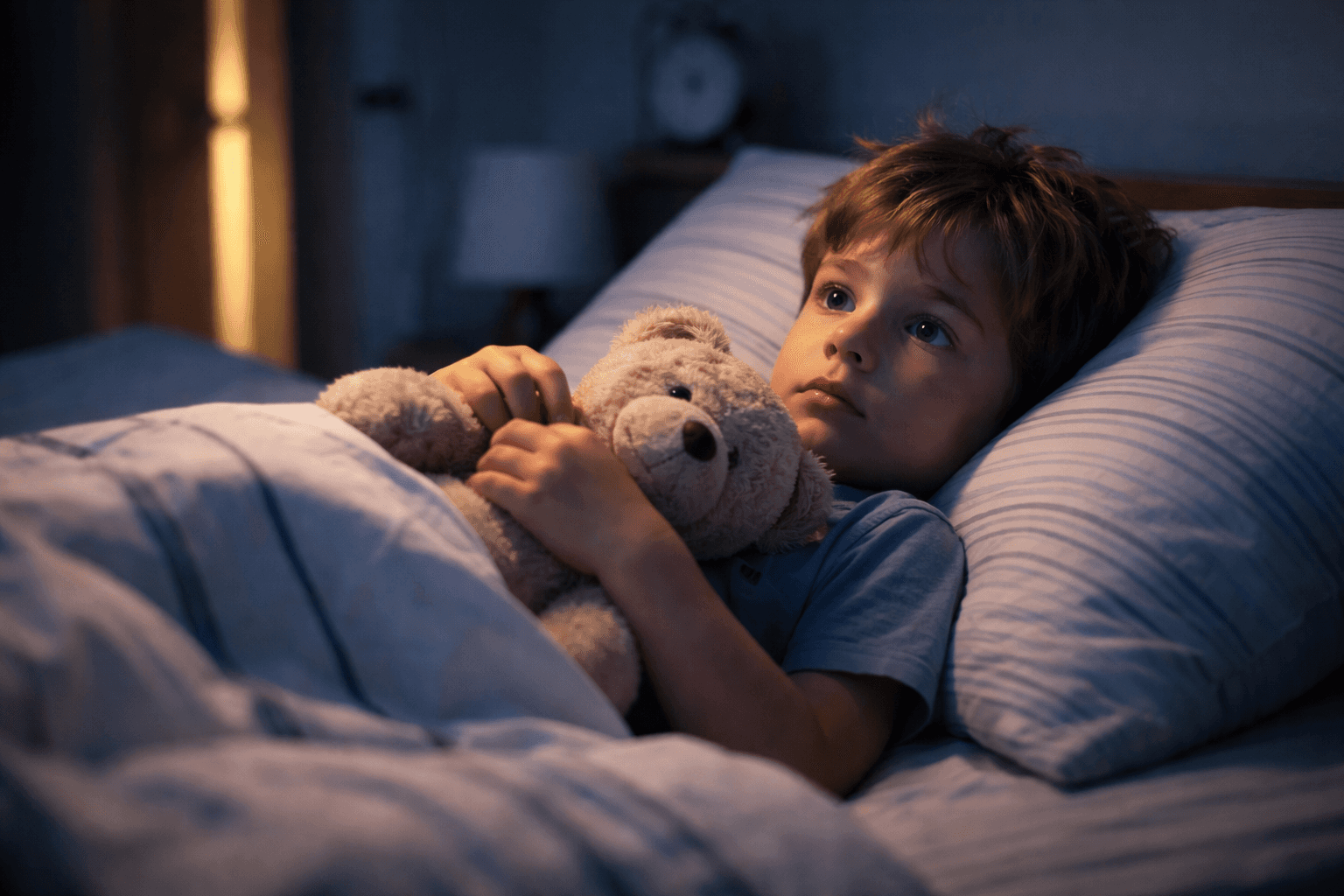
If your child is refusing sleep without the lights on, you're not imagining it, and you're definitely not alone. Fear of the dark is one of the most common childhood fears, affecting upto 80% of kids. Here's everything you need to know about why it happens and how to help.
If your child is refusing sleep without the lights on, you're not imagining it, and you're definitely not alone. Fear of the dark is one of the most common childhood fears, affecting upto 80% of kids. Here's everything you need to know about why it happens and how to help.
The challenge
The challenge
Bedtime has become a battle. Your child won't go to sleep without every light on, calls you back into the room repeatedly, or wakes up in the night in a panic. What used to be a simple routine now feels like a nightly negotiation, and it's taking a toll on the whole family. You know your child isn't making it up, but you don't know what's causing it or how to make it stop.
Bedtime has become a battle. Your child won't go to sleep without every light on, calls you back into the room repeatedly, or wakes up in the night in a panic. What used to be a simple routine now feels like a nightly negotiation, and it's taking a toll on the whole family. You know your child isn't making it up, but you don't know what's causing it or how to make it stop.
Bedtime has become a battle. Your child won't go to sleep without every light on, calls you back into the room repeatedly, or wakes up in the night in a panic. What used to be a simple routine now feels like a nightly negotiation, and it's taking a toll on the whole family. You know your child isn't making it up, but you don't know what's causing it or how to make it stop.
Josh E
Josh E
The Journey
The Journey
Having trouble getting the little one to sleep? Has your child suddenly started crying at bedtime, refusing to be left alone in a dark room, or waking yup in the night convinced something is hiding in the shadows? Whether this fear has appeared out of nowhere or has been building for a while, it can be exhausting and heart breaking to watch. The good news is, its's completely normal, and there's plenty you can do about it.
Introduction
Does your child refuse to sleep with the lights off? Do they call out in the night, convinced something is lurking in the shadows? You are not alone, and neither are they.
Fear of the dark is one of the most common childhood fears in the world. Studies suggest that between 40% and 80% of children experience some degree of fear of the dark between the ages of 2 and 10. But why does darkness trigger such intense anxiety in young children, and when does a normal developmental fear become something to take more seriously?
In this article, we explore the psychology and science behind why children are scared of the dark, how age and development play a role, and, most importantly, what parents and caregivers can do to help.
What Is Fear of the Dark in Children?
Fear of the dark — clinically referred to as nyctophobia — is an emotional response to the absence of light. In children, this fear is rarely about darkness itself. Rather, it is about what the darkness represents: the unknown, the unseen, and the uncontrollable.
Unlike adults who have developed cognitive tools to manage uncertainty, children are still building the mental frameworks that help them distinguish between imagination and reality. This makes the dark a uniquely potent trigger for anxiety.
Why Are Children Scared of the Dark? 7 Key Reasons
1. The Developing Imagination
One of the primary reasons children fear the dark is their rapidly developing imagination. Between the ages of 2 and 7, children enter what developmental psychologist Jean Piaget called the preoperational stage — a period of rich, symbolic thinking where the boundaries between fantasy and reality are blurry.
A shadow on the wall is not just a shadow — it is a monster. A creak in the floorboards is not the house settling — it is something approaching. The very creativity that makes children wonderful storytellers also makes them more susceptible to fear.
2. Loss of Visual Control
Human beings are fundamentally visual creatures. In daylight, we can assess our environment and feel safe. When the lights go out, that sense of visual control is removed.
For children who are already navigating a world in which they have limited control — over their schedule, their relationships, their bodies — darkness amplifies that vulnerability. It removes the one sense that gives them the most reassurance.
3. Evolutionary Origins of Darkness Fear
Fear of the dark may have deep evolutionary roots. Throughout human prehistory, darkness signalled genuine danger — predators, threats, and the unknown. Our nervous systems evolved to respond to darkness with heightened alertness.
Children, whose threat-detection systems are still calibrated to be maximally sensitive, are particularly responsive to this ancient alarm. In this light, a child's fear of the dark is not irrational — it is biology doing exactly what it was designed to do.
4. Night time Separation Anxiety
For many children, especially toddlers and young children, the fear of the dark is closely linked to separation anxiety. Being alone in a dark room means being separated from caregivers — the people who make the world feel safe.
The dark, in this context, becomes a symbol of abandonment and helplessness. This is particularly common in children aged 18 months to 4 years, who are in a critical window of attachment development.
5. Media and Stories
Children's exposure to scary imagery, stories, and media plays a significant role. Fairy tales, cartoons, and even well-meaning bedtime stories often feature monsters, witches, and dark forests. Even content intended to be mild can plant seeds of imagination that bloom into fear when the lights go out.
Research published in Sleep Medicine Reviews highlights that screen exposure before bedtime — including content children may not consciously find scary — can increase night time anxiety and fear.
6. Temperament and Sensitivity
Not all children experience darkness the same way. Children with highly sensitive temperaments — those who process sensory and emotional information more deeply — are more likely to develop intense fears of the dark.
These children are not "overreacting." Their nervous systems are wired to respond more intensely to stimuli, including the ambiguity and stillness of darkness. Understanding this temperament is key for parents seeking to support their child effectively.
7. Life Stressors and Anxiety
A sudden or intensifying fear of the dark can also signal underlying stress or anxiety in a child's life. Changes such as starting a new school, the arrival of a sibling, family tension, or other disruptions can manifest as heightened night time fear.
In these cases, the fear of darkness is less about the dark itself and more about a child seeking safety and reassurance during an uncertain time.
Introduction
Does your child refuse to sleep with the lights off? Do they call out in the night, convinced something is lurking in the shadows? You are not alone, and neither are they.
Fear of the dark is one of the most common childhood fears in the world. Studies suggest that between 40% and 80% of children experience some degree of fear of the dark between the ages of 2 and 10. But why does darkness trigger such intense anxiety in young children, and when does a normal developmental fear become something to take more seriously?
In this article, we explore the psychology and science behind why children are scared of the dark, how age and development play a role, and, most importantly, what parents and caregivers can do to help.
What Is Fear of the Dark in Children?
Fear of the dark — clinically referred to as nyctophobia — is an emotional response to the absence of light. In children, this fear is rarely about darkness itself. Rather, it is about what the darkness represents: the unknown, the unseen, and the uncontrollable.
Unlike adults who have developed cognitive tools to manage uncertainty, children are still building the mental frameworks that help them distinguish between imagination and reality. This makes the dark a uniquely potent trigger for anxiety.
Why Are Children Scared of the Dark? 7 Key Reasons
1. The Developing Imagination
One of the primary reasons children fear the dark is their rapidly developing imagination. Between the ages of 2 and 7, children enter what developmental psychologist Jean Piaget called the preoperational stage — a period of rich, symbolic thinking where the boundaries between fantasy and reality are blurry.
A shadow on the wall is not just a shadow — it is a monster. A creak in the floorboards is not the house settling — it is something approaching. The very creativity that makes children wonderful storytellers also makes them more susceptible to fear.
2. Loss of Visual Control
Human beings are fundamentally visual creatures. In daylight, we can assess our environment and feel safe. When the lights go out, that sense of visual control is removed.
For children who are already navigating a world in which they have limited control — over their schedule, their relationships, their bodies — darkness amplifies that vulnerability. It removes the one sense that gives them the most reassurance.
3. Evolutionary Origins of Darkness Fear
Fear of the dark may have deep evolutionary roots. Throughout human prehistory, darkness signalled genuine danger — predators, threats, and the unknown. Our nervous systems evolved to respond to darkness with heightened alertness.
Children, whose threat-detection systems are still calibrated to be maximally sensitive, are particularly responsive to this ancient alarm. In this light, a child's fear of the dark is not irrational — it is biology doing exactly what it was designed to do.
4. Night time Separation Anxiety
For many children, especially toddlers and young children, the fear of the dark is closely linked to separation anxiety. Being alone in a dark room means being separated from caregivers — the people who make the world feel safe.
The dark, in this context, becomes a symbol of abandonment and helplessness. This is particularly common in children aged 18 months to 4 years, who are in a critical window of attachment development.
5. Media and Stories
Children's exposure to scary imagery, stories, and media plays a significant role. Fairy tales, cartoons, and even well-meaning bedtime stories often feature monsters, witches, and dark forests. Even content intended to be mild can plant seeds of imagination that bloom into fear when the lights go out.
Research published in Sleep Medicine Reviews highlights that screen exposure before bedtime — including content children may not consciously find scary — can increase night time anxiety and fear.
6. Temperament and Sensitivity
Not all children experience darkness the same way. Children with highly sensitive temperaments — those who process sensory and emotional information more deeply — are more likely to develop intense fears of the dark.
These children are not "overreacting." Their nervous systems are wired to respond more intensely to stimuli, including the ambiguity and stillness of darkness. Understanding this temperament is key for parents seeking to support their child effectively.
7. Life Stressors and Anxiety
A sudden or intensifying fear of the dark can also signal underlying stress or anxiety in a child's life. Changes such as starting a new school, the arrival of a sibling, family tension, or other disruptions can manifest as heightened night time fear.
In these cases, the fear of darkness is less about the dark itself and more about a child seeking safety and reassurance during an uncertain time.
"Fear of the dark is not a behavioural problem to be corrected. It is a developmental milestone to be understood, and with the right support, most children move through it naturally." Josh E
"Fear of the dark is not a behavioural problem to be corrected. It is a developmental milestone to be understood, and with the right support, most children move through it naturally." Josh E
Josh E
Josh E
"Fear of the dark is not a behavioural problem to be corrected. It is a developmental milestone to be understood, and with the right support, most children move through it naturally." Josh E
Josh E
At What Age Is Fear of the Dark Normal?
Fear of the dark is developmentally normal across a wide age range:
Age Group | What to Expect |
|---|---|
18 months – 3 years | Separation anxiety peaks; darkness linked to being alone |
3 – 6 years | Imagination intensifies; monsters and shadows become vivid |
6 – 9 years | Fears often persist; children understand more but worry more too |
9 – 12 years | Most children outgrow it, though some remain sensitive |
If fear of the dark is persistent beyond age 10, significantly disrupting sleep or daily functioning, it may be worth consulting a paediatric psychologist or child therapist.
Signs Your Child's Fear of the Dark May Need Professional Support
While most childhood fear of darkness is normal and temporary, look out for:
Severe sleep disruption lasting weeks or months
Panic attacks or extreme physical symptoms at bedtime (hyperventilation, shaking, vomiting)
Fear spreading beyond bedtime into daytime avoidance of dark spaces
Significant impact on school performance or mood
No improvement despite consistent parenting strategies
These signs may indicate a clinical anxiety disorder that would benefit from professional assessment and support.
How to Help a Child Who Is Scared of the Dark: 10 Expert-Backed Strategies
1. Validate Their Fear — Never Dismiss It
The single most important thing a parent can do is take the fear seriously. Telling a child "there's nothing to be scared of" or "don't be silly" is counterproductive. It signals that their feelings are wrong, which increases anxiety and erodes trust.
Instead, say: "I understand that feels scary. Let's figure this out together."
2. Use a Night Light
A soft, warm night light can be transformative. It does not signal weakness — it is a practical tool that restores a child's sense of visual safety without fully disrupting sleep cues.
Choose warm amber or red tones, which have minimal impact on melatonin production compared to blue-white lights.
3. Create a Consistent Bedtime Routine
Predictability reduces anxiety. A consistent wind-down routine — bath, story, dim lights, quiet music — tells a child's nervous system that sleep is safe. Over time, the routine itself becomes a cue for calm.
4. Explore the Dark Together
Gradually helping children become familiar with darkness — through play — can reduce its power. Try torch games, shadow puppets, or stargazing together. This reframes darkness as something interesting rather than threatening.
5. Empower Your Child With a "Brave Tool"
Give children a sense of agency over their fear. This might be a special torch, a "monster spray" (water in a spray bottle), a comfort object, or a brave-kid bracelet. The object itself matters less than the feeling of control it provides.
6. Limit Scary Content Before Bedtime
Review what your child watches and reads in the hour before bed. Even mild supernatural content can fuel nighttime imagination. Opt for calm, positive stories at bedtime.
7. Use Relaxation Techniques
Simple breathing exercises — like breathing in for 4 counts, holding for 4, out for 4 — activate the parasympathetic nervous system and reduce the physical symptoms of fear. Teach these during the day so children can use them at night.
8. Gradual Exposure
If your child's fear is strong, consider a gradual desensitisation approach: start with a dimly lit room, then progressively reduce the light over days or weeks. Reward bravery with praise rather than treats.
9. Check In About Daytime Worries
Ask your child open questions about their day. Unaddressed worries often resurface as nighttime fear. Giving children space to talk through stress during the day can reduce its nocturnal expression.
10. Model Calm Confidence
Children pick up on parental anxiety. If you approach bedtime with calm confidence — neither dismissing the fear nor amplifying it with your own worry — your child will sense that the situation is manageable.
Frequently Asked Questions
Is it normal for a 7-year-old to be scared of the dark?
Yes, absolutely. Fear of the dark is very common in children aged 3 to 9. Most children outgrow it naturally with gentle support and reassurance.
What causes sudden fear of the dark in a child who was previously fine?
A sudden onset of fear often signals a life stressor — a change at school, at home, or in their social world. It can also follow exposure to a scary story or image. Exploring what has changed in your child's life is a helpful first step.
When does fear of the dark become a phobia?
A fear becomes a clinical phobia (nyctophobia) when it is intense, persistent, and significantly interferes with daily life. If your child's fear is severely disrupting sleep, causing panic, or spreading into daytime avoidance, consult a professional.
Should I leave my child's bedroom door open?
Yes, for many children a partially open door provides significant comfort. It maintains a connection to the rest of the home and reduces the sense of isolation that the dark can intensify.
Children's fear of the dark is not a flaw or a weakness — it is a natural, often temporary part of growing up. Rooted in developmental psychology, evolutionary biology, and the beautiful chaos of a child's imagination, it deserves to be met with empathy, creativity, and patience.
By understanding why children are scared of the dark, parents and caregivers are far better equipped to help. With consistent support, gradual empowerment, and the occasional night light, most children move through this fear and into more confident, restful nights.
At What Age Is Fear of the Dark Normal?
Fear of the dark is developmentally normal across a wide age range:
Age Group | What to Expect |
|---|---|
18 months – 3 years | Separation anxiety peaks; darkness linked to being alone |
3 – 6 years | Imagination intensifies; monsters and shadows become vivid |
6 – 9 years | Fears often persist; children understand more but worry more too |
9 – 12 years | Most children outgrow it, though some remain sensitive |
If fear of the dark is persistent beyond age 10, significantly disrupting sleep or daily functioning, it may be worth consulting a paediatric psychologist or child therapist.
Signs Your Child's Fear of the Dark May Need Professional Support
While most childhood fear of darkness is normal and temporary, look out for:
Severe sleep disruption lasting weeks or months
Panic attacks or extreme physical symptoms at bedtime (hyperventilation, shaking, vomiting)
Fear spreading beyond bedtime into daytime avoidance of dark spaces
Significant impact on school performance or mood
No improvement despite consistent parenting strategies
These signs may indicate a clinical anxiety disorder that would benefit from professional assessment and support.
How to Help a Child Who Is Scared of the Dark: 10 Expert-Backed Strategies
1. Validate Their Fear — Never Dismiss It
The single most important thing a parent can do is take the fear seriously. Telling a child "there's nothing to be scared of" or "don't be silly" is counterproductive. It signals that their feelings are wrong, which increases anxiety and erodes trust.
Instead, say: "I understand that feels scary. Let's figure this out together."
2. Use a Night Light
A soft, warm night light can be transformative. It does not signal weakness — it is a practical tool that restores a child's sense of visual safety without fully disrupting sleep cues.
Choose warm amber or red tones, which have minimal impact on melatonin production compared to blue-white lights.
3. Create a Consistent Bedtime Routine
Predictability reduces anxiety. A consistent wind-down routine — bath, story, dim lights, quiet music — tells a child's nervous system that sleep is safe. Over time, the routine itself becomes a cue for calm.
4. Explore the Dark Together
Gradually helping children become familiar with darkness — through play — can reduce its power. Try torch games, shadow puppets, or stargazing together. This reframes darkness as something interesting rather than threatening.
5. Empower Your Child With a "Brave Tool"
Give children a sense of agency over their fear. This might be a special torch, a "monster spray" (water in a spray bottle), a comfort object, or a brave-kid bracelet. The object itself matters less than the feeling of control it provides.
6. Limit Scary Content Before Bedtime
Review what your child watches and reads in the hour before bed. Even mild supernatural content can fuel nighttime imagination. Opt for calm, positive stories at bedtime.
7. Use Relaxation Techniques
Simple breathing exercises — like breathing in for 4 counts, holding for 4, out for 4 — activate the parasympathetic nervous system and reduce the physical symptoms of fear. Teach these during the day so children can use them at night.
8. Gradual Exposure
If your child's fear is strong, consider a gradual desensitisation approach: start with a dimly lit room, then progressively reduce the light over days or weeks. Reward bravery with praise rather than treats.
9. Check In About Daytime Worries
Ask your child open questions about their day. Unaddressed worries often resurface as nighttime fear. Giving children space to talk through stress during the day can reduce its nocturnal expression.
10. Model Calm Confidence
Children pick up on parental anxiety. If you approach bedtime with calm confidence — neither dismissing the fear nor amplifying it with your own worry — your child will sense that the situation is manageable.
Frequently Asked Questions
Is it normal for a 7-year-old to be scared of the dark?
Yes, absolutely. Fear of the dark is very common in children aged 3 to 9. Most children outgrow it naturally with gentle support and reassurance.
What causes sudden fear of the dark in a child who was previously fine?
A sudden onset of fear often signals a life stressor — a change at school, at home, or in their social world. It can also follow exposure to a scary story or image. Exploring what has changed in your child's life is a helpful first step.
When does fear of the dark become a phobia?
A fear becomes a clinical phobia (nyctophobia) when it is intense, persistent, and significantly interferes with daily life. If your child's fear is severely disrupting sleep, causing panic, or spreading into daytime avoidance, consult a professional.
Should I leave my child's bedroom door open?
Yes, for many children a partially open door provides significant comfort. It maintains a connection to the rest of the home and reduces the sense of isolation that the dark can intensify.
Children's fear of the dark is not a flaw or a weakness — it is a natural, often temporary part of growing up. Rooted in developmental psychology, evolutionary biology, and the beautiful chaos of a child's imagination, it deserves to be met with empathy, creativity, and patience.
By understanding why children are scared of the dark, parents and caregivers are far better equipped to help. With consistent support, gradual empowerment, and the occasional night light, most children move through this fear and into more confident, restful nights.
Ready to find your path?
Ready to find your path?
If this story resonates with you, maybe it’s time to start your own journey
If this story resonates with you, maybe it’s time to start your own journey
Prefer to chat first? Send me an email or connect with us on social, I'm always happy to help.
Prefer to chat first? Send me an email or connect with us on social, I'm always happy to help.